
Artificial intelligence is making knowledge work faster than ever. But I am beginning to wonder whether we are sacrificing something far more valuable than the time we save.
I have spent years studying AI and critical thinking, experimenting with emerging technologies, and exploring how businesses and individuals can use AI to become more productive.
And I genuinely believe AI is one of the most transformative technologies of our time.
But recently, a question has been bothering me.
What if artificial intelligence makes us incredibly productive while gradually reducing our ability to think independently?
Think about an ordinary working day.
Someone needs to write a business proposal. They ask AI.
A student needs to complete an assignment. They ask AI.
An entrepreneur wants to evaluate a startup idea. They ask AI.
A manager needs to make a difficult decision. They ask AI.
And within seconds, they receive something that appears intelligent, logical, and professionally structured.
The work is completed.
Time is saved.
Productivity increases.
But I want to ask a different question.
Did the person actually become more capable, or did the technology simply complete the task on their behalf?
I believe this distinction could become one of the most important discussions in the next phase of the AI revolution.
A Recent Stanford Study Raises an Uncomfortable Question
On November 4, 2026, researchers at Stanford University discussed how artificial intelligence is changing the way people learn.
Their findings focused on something known as cognitive offloading.
In simple terms, cognitive offloading happens when we transfer part of our mental work to an external tool.
This is not a new phenomenon.
We use calculators instead of performing complicated calculations mentally.
We use GPS systems instead of memorizing every route.
We use search engines instead of remembering every piece of information.
There is nothing inherently wrong with this.
In fact, delegating certain activities can free our attention for more valuable work.
But AI introduces an important difference.
Instead of merely helping us perform a particular calculation or retrieve information, it can potentially complete an entire intellectual task.
Stanford researchers examined evidence from hundreds of studies and highlighted concerns about what happens when students delegate too much of the learning process to AI.
In one study involving Brazilian students, learners who relied heavily on AI initially benefited from its assistance. However, when the tool was removed, their creative performance declined relative to students who had not used it.
The researchers also emphasized that evidence remains limited and outcomes depend heavily on how AI tools are designed and used.
I find this research important.
Not because it proves AI is making everyone less intelligent.
It doesn’t.
But because it raises a question I believe deserves much more attention.
Are we using AI to strengthen our thinking, or are we gradually replacing the process of thinking itself?
The Most Dangerous Outcome May Be the Illusion of Expertise
Imagine a young professional preparing a detailed market analysis.
They provide a few instructions to an AI system.
Within minutes, the system produces a beautifully structured report.
It includes market opportunities, competitor analysis, industry risks, and strategic recommendations.
The professional reads it and feels satisfied.
The report looks impressive.
But what happens when a senior executive asks an unexpected question?
Why did you select this market?
Which assumption is most vulnerable?
What happens if customer demand falls by 20%?
Which data supports your recommendation?
If the professional cannot explain the reasoning behind the report, how much expertise have they actually developed?
This is the problem I find particularly concerning.
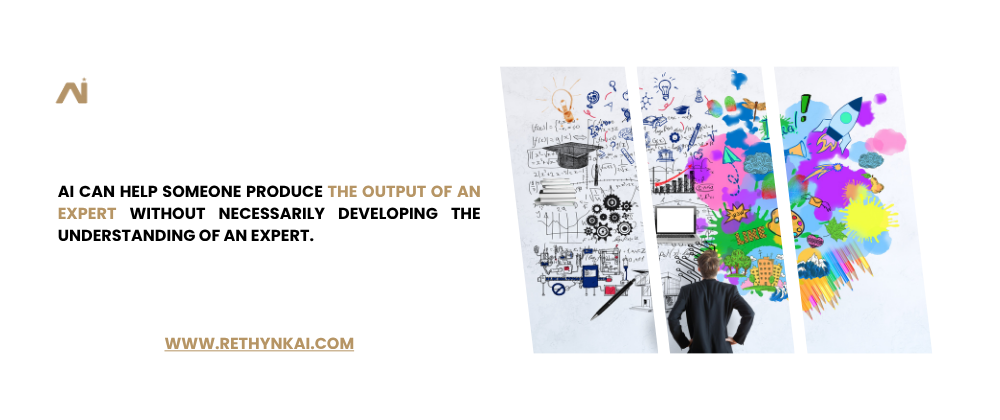
AI can help someone produce the output of an expert without necessarily developing the understanding of an expert.
And I think this creates a dangerous illusion.
We may begin confusing the quality of the material we produce with the quality of our own understanding.
I have seen how easily AI can generate confident explanations, business strategies, and sophisticated technical documents.
But a well-written answer is not necessarily a well-understood answer.
That distinction matters enormously in professional life.
I Have Become More Interested in Teaching People How to Think With AI
When I speak about artificial intelligence, I want people to understand something beyond the latest tools and features.
Anyone can learn to enter a prompt.
A new application can make that process even easier.
But knowing which button to press is not the same as understanding how to solve a problem.
My interest lies in helping people develop the ability to think with AI.
To ask better questions.
To challenge assumptions.
To identify weak reasoning.
To recognize when an AI-generated answer does not make sense.
And to understand why a particular decision should or should not be made.
This philosophy comes partly from my background in engineering and Lean Six Sigma.
In process excellence, we do not simply accept the first explanation for a problem.
We investigate.
We examine evidence.
We identify root causes.
We question assumptions.
And we test whether an intervention actually improves the outcome.
I believe AI should be used with a similar mindset.
It should not simply provide answers. It should help us investigate the quality of our questions.
What Happens When Entrepreneurs Stop Questioning?
I think this problem could become particularly serious in entrepreneurship.
Imagine a founder asking AI:
“Give me a billion-dollar startup idea.”
The system produces an exciting concept.
Then the founder asks for a business plan.
AI creates one.
Next comes a pitch deck, marketing strategy, financial forecast, and product roadmap.
Within a day, the founder has what appears to be an entire company on paper.
But has anyone spoken with a potential customer?
Has the problem been validated?
Does anyone actually need the proposed solution?
Will customers pay for it?
These questions remain unanswered.
This is something I have become increasingly conscious of while building ReThynk AI.
Technology can accelerate execution.
But it cannot replace the responsibility of understanding the problem being solved.
And I believe founders who confuse AI-generated business plans with actual business validation may eventually pay a substantial price.
A beautifully generated strategy is worthless if the assumptions behind it are wrong.
Sometimes, the most valuable thing a founder can do is reject an impressive AI-generated recommendation.
That requires judgment.
And judgment develops through experience, questioning, and reflection.
Even Experienced Professionals May Become Vulnerable
This problem is not limited to students and beginners.
Microsoft Research published a study in 2025 examining the relationship between generative AI and critical thinking among 319 knowledge workers.
Participants described 936 examples of AI use in their professional activities.
The researchers found that greater confidence in AI was associated with less self-reported critical thinking, while greater confidence in one’s own abilities was associated with more.
The study did not establish that AI caused a lasting decline in cognitive ability.
But I think the association is worth considering.
When people become highly confident in a technology, they may become less inclined to question its outputs.
Imagine an experienced manager receiving a detailed recommendation from an AI system.
The analysis appears reasonable.
The numbers look convincing.
The writing is professional.
The manager approves the recommendation without adequately examining the assumptions.
Now imagine a similar process happening across thousands of organizations.
We could create a world where decisions are increasingly assisted by sophisticated technology, but the humans responsible for those decisions are not always critically engaged.
The danger is not simply that AI might make mistakes. It is that humans may become less likely to recognize those mistakes.
That is a different kind of risk.
We Are Removing the Struggle That Often Creates Understanding
One of the most important lessons I have learned from engineering, research, and entrepreneurship is that understanding frequently develops through difficulty.
You encounter a problem.
Your first solution fails.
You investigate what happened.
You reconsider your assumptions.
You experiment again.
Eventually, you understand something that was not obvious at the beginning.
AI can make this process much faster.
That can be wonderful.
But I wonder whether we are also removing some of the experiences that make us better problem-solvers.
If a student receives the answer immediately, they may never explore why their initial reasoning was incorrect.
If a developer copies AI-generated code without understanding its architecture, they may struggle when an unexpected failure occurs.
If a researcher accepts an AI-generated interpretation without examining the original evidence, they may overlook important limitations.
Of course, unnecessary frustration does not automatically create learning.
Not every difficult task deserves to remain difficult.
But some forms of intellectual effort are valuable precisely because they force us to develop understanding.
The challenge is knowing which effort should be automated and which effort should be preserved.
I believe this distinction will become increasingly important in education and professional development.
My Suggestion: Don't Let AI Have the First and Last Word
I don’t believe the answer is to use AI less for everything.
I believe the answer is to use AI more deliberately.
For important problems, I would encourage people to develop an initial point of view before asking AI for assistance.
What do you think is happening?
What evidence do you already have?
What assumptions are you making?
Then bring AI into the process.
Ask it to identify weaknesses in your argument.
Ask for alternative explanations.
Ask which information is missing.
Ask it to challenge your conclusion rather than simply strengthen it.
Afterward, examine the evidence and make your own decision.
Finally, try explaining your reasoning without relying on the AI-generated response.
If you cannot explain why you reached a conclusion, perhaps you have not understood the problem sufficiently.
This is particularly important for decisions involving money, safety, employees, customers, or long-term business strategy.
I want AI to improve the quality of human judgment. Not quietly replace it.
There Is Also a Positive Future Worth Building
I don’t want this article to become another argument that artificial intelligence is destroying human capabilities.
That would be an oversimplification.
AI can also create extraordinary learning opportunities.
A student who cannot afford private tutoring may receive personalized explanations.
A researcher may explore unfamiliar concepts more efficiently.
A professional entering a new industry can ask questions without feeling embarrassed.
An entrepreneur may use AI to examine possibilities that would otherwise require substantial time and resources.
I believe these advantages are real.
The question is how we design the interaction.
Does the system provide every answer immediately?
Or does it encourage the learner to investigate?
Does it simply generate a final report?
Or does it help the professional understand the evidence?
Does it agree with the user?
Or does it constructively challenge the user’s assumptions?
Stanford’s researchers emphasized that AI tools designed with guided questioning and appropriate learning support may produce better educational outcomes than tools that simply provide complete answers.
I think that principle extends far beyond education.
The best AI assistant may not always be the one that completes the task fastest.
Sometimes, the best AI assistant is the one that makes the human better at completing the next task independently.
Final Thoughts: We Must Not Confuse Artificial Intelligence With Human Wisdom
I believe artificial intelligence will become increasingly integrated into our lives.
We will use it for research, writing, coding, business decisions, scientific discovery, and activities we cannot yet fully imagine.
And I welcome much of that progress.
But I also believe we need to protect something fundamental.
Our ability to reason.
To question.
To disagree.
To recognize uncertainty.
To learn through experience.
And to make decisions for which we are willing to accept responsibility.
A future where AI helps people develop stronger judgment could be extraordinary.
A future where people simply accept increasingly sophisticated machine-generated answers could be far less encouraging.
The difference may not depend entirely on how intelligent AI becomes.
It may depend on how we choose to use it.
As an entrepreneur and researcher, I want to build and encourage AI systems that expand human capability.
Not merely systems that produce more content, faster reports, and impressive demonstrations.
Because I am beginning to believe that one of the most important skills of the AI era will be knowing when not to delegate our thinking.
And perhaps the greatest mistake we could make would be celebrating how much work AI can do for us while forgetting to ask how much we are still learning to do ourselves.
The real promise of artificial intelligence is not that humans will no longer need to think.
It is that humans could become capable of thinking, discovering, and creating at levels we could not previously achieve.
That is the AI revolution I want to contribute to.
— Jaideep Parashar
Founder & Director, ReThynk AI Innovation and Research Pvt. Ltd.
Hand Picked Article from Team ReThynk: AI Bubble Burst: Could a Bigger Market Shock is Coming?
Research Reference:
1. Stanford University: Stanford Report
2. Microsoft Research: The Impact of GenAI on Critical Thinking
3. Nature.com: Communications Psychology