
An AI Evaluation Framework gives organizations a structured way to determine whether an AI system is actually working—not simply whether it has been deployed. As AI moves from experimentation into real business operations, measuring quality, reliability, risk, and business impact becomes essential.
I have noticed an interesting shift in conversations around AI.
A few years ago, the primary question was:
“Can we build it?”
Then the question became:
“Can we deploy it?”
Today, I believe organizations need to ask a more important question:
“Can we prove that it is working?”
That question changes the entire approach to AI implementation.
An AI system can produce impressive demonstrations and still fail in production. It can generate technically acceptable responses while creating unnecessary operational costs. It can automate a process while increasing risk. It can save employees time while producing outcomes that customers do not value.
This is why I believe AI evaluation should be treated as an operational discipline, not simply a technical testing exercise.
In my work across Artificial Intelligence, Lean Six Sigma, process improvement, and systems thinking, one principle has remained consistent:
If you cannot measure the improvement, you cannot prove the improvement.
That principle becomes even more important when AI is involved.
Key Takeaways
- AI evaluation should measure more than model accuracy.
- Technical performance and business performance are not the same thing.
- AI systems should be evaluated before deployment and continuously after deployment.
- Quality, reliability, robustness, efficiency, safety, human effectiveness, and business value should be considered together.
- AI evaluation should feed directly into continuous improvement.
What Is an AI Evaluation Framework?
An AI Evaluation Framework is a structured methodology for assessing whether an AI system meets its intended technical, operational, safety, and business objectives.
It establishes what should be measured, how it should be measured, when it should be measured, and what should happen when performance falls below expectations.
A mature evaluation framework should answer questions such as:
- Is the AI producing accurate results?
- Is it consistent?
- Does it behave appropriately under unusual conditions?
- Is it creating measurable efficiency?
- Does it introduce unacceptable risks?
- Are employees making better decisions because of it?
- Is the organization actually achieving the intended business outcome?
These questions are closely aligned with the broader philosophy behind Agentic Process Excellence™.
In my article, What Is Agentic Process Excellence? A Practical Framework for AI-Powered Continuous Improvement, I explained why AI should not simply automate activities. It should contribute to processes that can continuously improve.
Evaluation is what makes that continuous improvement possible.
Why AI Evaluation Is Becoming Essential
There is a major difference between an AI system that works in a demonstration and an AI system that works reliably in a business environment.
A prototype may be tested using a handful of carefully selected examples.
A production system encounters:
- Unexpected inputs
- Ambiguous requests
- Incomplete information
- Edge cases
- Different users
- Changing business conditions
- Data quality problems
- Security risks
That is why evaluation cannot end when an AI system goes live.
The National Institute of Standards and Technology (NIST) places measurement at the center of AI risk management and recommends testing AI systems before deployment and regularly during operation. Its AI Risk Management Framework organizes AI risk activities around Govern, Map, Measure, and Manage, with measurement feeding ongoing risk management.
Microsoft’s current guidance similarly treats evaluation as something that can happen both before deployment and after deployment, using measures of performance, quality, and safety.
The message is clear:
AI evaluation is not a launch-day activity. It is a lifecycle activity.
The ReThynk AI Evaluation Scorecard™
Based on my experience with process improvement and AI systems, I believe organizations should evaluate AI across seven dimensions.
I call this the:
ReThynk AI Evaluation Scorecard™
The seven dimensions are:
- Accuracy
- Reliability
- Robustness
- Efficiency
- Safety
- Human Effectiveness
- Business Value
These dimensions are deliberately broader than traditional model evaluation.
Why?
Because an AI system does not operate in a vacuum.
It operates inside a business process.
And ultimately, the business cares about outcomes.
1. Accuracy
The first question is straightforward:
Is the AI producing correct results?
Accuracy is particularly important for systems where incorrect information can directly affect business decisions.
Depending on the use case, accuracy may involve:
- Correct classifications
- Correct calculations
- Correct information retrieval
- Appropriate recommendations
- Accurate extraction of information
- Correct tool selection
For a document-processing system, for example, you might measure how often it correctly extracts important fields.
For a customer-support system, you might measure whether the response accurately reflects the organization’s policies and available information.
For an AI coding assistant, you might evaluate whether generated code passes predefined tests.
But accuracy has a limitation.
A system can be accurate on average and still fail badly in specific high-risk situations.
That is why accuracy should never be the only metric.
2. Reliability
Accuracy asks:
“Was the result correct?”
Reliability asks:
“Can we consistently depend on the system?”
These are different questions.
Imagine an AI system that produces excellent results 95% of the time but behaves unpredictably during the remaining 5%.
For a low-risk application, that might be acceptable.
For a financial, healthcare, legal, security, or critical operational process, it might not be.
Reliability can be evaluated through:
- Consistency across repeated tests
- Failure frequency
- Service availability
- Error rates
- Response stability
- Recovery from failures
A mature AI Evaluation Framework therefore needs to examine not only average performance but also variation.
This is where Six Sigma thinking becomes particularly relevant.
Average performance can hide variation.
And variation can create risk.
3. Robustness
Real-world environments are messy.
Users do not always provide clean inputs.
Data can be incomplete.
Questions can be ambiguous.
Systems can behave differently under unusual conditions.
Robustness measures how well an AI system handles that variation.
A robust AI system should be tested with:
- Unexpected inputs
- Incomplete information
- Ambiguous instructions
- Unusual formatting
- Adversarial inputs
- Edge cases
- Changing context
Microsoft’s current AI evaluation guidance specifically highlights the importance of representative evaluation data, edge cases, and robustness testing when evaluating AI applications and agents.
A simple principle
A system should not only work when everything goes right. It should behave appropriately when things go wrong.
That is what robustness is really about.
4. Efficiency
An AI system can be technically impressive and still be economically inefficient.
Suppose an AI workflow saves an employee 30 minutes per day but requires expensive infrastructure, extensive human review, and significant maintenance.
Did the organization actually become more efficient?
Not necessarily.
Efficiency should therefore measure the relationship between AI capability and resources consumed.
Useful metrics include:
- Processing time
- Cost per transaction
- Human intervention time
- Compute consumption
- Number of manual steps
- Throughput
- Cost savings
For example:
Before AI
100 customer requests
↓
8 employees
↓
6 hours
After AI
100 customer requests
↓
AI Workflow + 3 employees
↓
3 hours
That is a measurable operational improvement.
But we should go one step further.
We should ask:
Did customer outcomes remain the same or improve?
That brings us to the next dimension.
5. Safety
An AI system can be accurate and efficient while still creating unacceptable risk.
Safety evaluation should consider:
- Harmful outputs
- Privacy risks
- Security vulnerabilities
- Bias
- Unauthorized actions
- Unsafe recommendations
- Data leakage
- Inappropriate tool usage
NIST’s AI RMF emphasizes trustworthy characteristics including validity and reliability, safety, security and resilience, accountability and transparency, explainability and interpretability, privacy, and fairness with harmful bias managed.
This is one reason evaluation and governance cannot be separated.
In AI Governance Framework: A Practical Guide for Responsible AI Implementation, I discussed why organizations need governance mechanisms around AI systems rather than treating governance as a compliance exercise added after deployment.
An AI evaluation program should therefore feed directly into governance decisions.
If a system consistently fails a critical safety threshold, the correct response may not be to deploy it.
The correct response may be to redesign it.
6. Human Effectiveness
This is one of the metrics I believe organizations frequently overlook.
AI is often introduced to help employees.
So we should measure whether it actually helps them.
Consider an AI assistant that generates recommendations for customer-service employees.
We could measure:
- Response accuracy
- Response time
- Cost per interaction
But we should also ask:
- Are employees making better decisions?
- Are they spending less time searching for information?
- Are they handling more complex cases?
- Has cognitive workload decreased?
- Are employees overriding the AI frequently?
- Do employees trust the recommendations appropriately?
Human-AI collaboration should be evaluated as a system.
This connects directly with my thinking around AI Workflows.
In Why AI Workflows Matter More Than Standalone AI Agents: 7 Essential Reasons, I argued that business value comes from connecting AI capabilities into effective workflows rather than simply deploying isolated agents.
The same principle applies to evaluation.
Do not evaluate the AI in isolation. Evaluate the human-AI system.
7. Business Value
This is ultimately the most important question:
Did the AI improve the business?
Everything else should eventually connect to this question.
Business-value metrics may include:
- Revenue growth
- Cost reduction
- Cycle-time reduction
- Error reduction
- Customer satisfaction
- Employee productivity
- Conversion rates
- Retention
- Operational capacity
For example, suppose an AI customer-service system has:
- 95% response accuracy
- 99% availability
- Excellent safety scores
Those numbers sound impressive.
But if customer satisfaction falls and the cost per resolved case increases, the implementation cannot be considered successful.
This is why I believe:
Technical success is not the same as business success.
An AI system should ultimately be evaluated against the problem it was introduced to solve.
The AI Evaluation Scorecard™
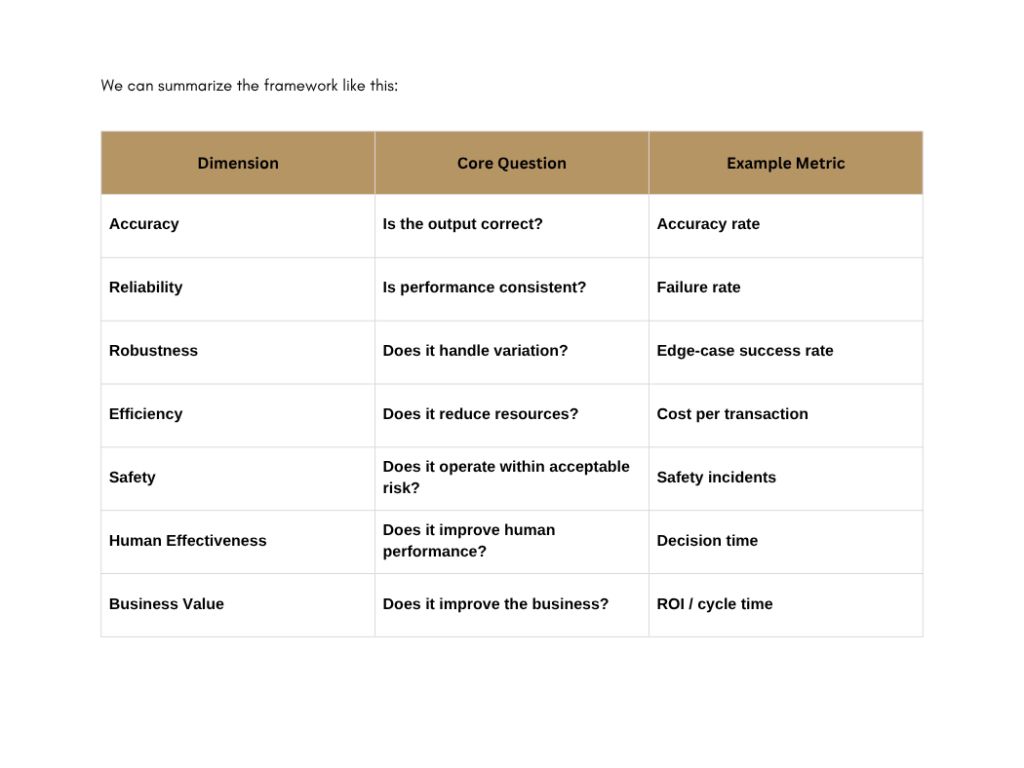
The important point is that these metrics should not operate independently.
They form a system.
Improving one dimension can sometimes negatively affect another.
For example:
A highly restrictive AI system may reduce risk but also reduce usefulness.
A highly autonomous system may increase efficiency but increase operational risk.
A more accurate model may require more computational resources.
This is why AI evaluation is ultimately a systems problem.
How to Build an AI Evaluation Process
A practical evaluation process can follow six steps.
Step 1: Define the Business Objective
Start with the problem.
Do not start with the model.
Ask:
What are we trying to improve?
For example:
- Reduce customer response time by 40%.
- Reduce invoice-processing errors by 30%.
- Reduce research time by 50%.
The objective should be measurable.
Step 2: Establish a Baseline
This is where process improvement discipline becomes extremely valuable.
Before introducing AI, measure the existing process.
Record:
- Current cycle time
- Current error rate
- Current cost
- Current productivity
- Current customer outcome
Without a baseline, improvement becomes difficult to prove.
This principle connects directly with How Lean Six Sigma and AI Create Better Business Processes, where I explore how AI can become more effective when combined with structured process improvement.
Step 3: Define Evaluation Metrics
Select metrics that correspond to the business objective.
Do not measure everything simply because you can.
Choose metrics that answer meaningful questions.
For example:
Objective: Reduce customer-support resolution time.
Possible metrics:
- Average resolution time
- First-contact resolution
- Escalation rate
- Response accuracy
- Customer satisfaction
- Human intervention rate
Step 4: Test Before Deployment
AI systems should be tested using realistic data and scenarios before they reach production.
Testing should include:
- Normal cases
- Difficult cases
- Edge cases
- Adversarial cases
- Failure scenarios
Microsoft’s current evaluation guidance recommends using evaluation datasets and appropriate evaluators to assess AI quality, performance, and safety before deployment.
NIST similarly recommends testing before deployment and continuing measurement while the system operates.
Step 5: Monitor After Deployment
Deployment is not the end.
It is the beginning of real-world learning.
Monitor:
- Performance trends
- Errors
- User feedback
- Safety incidents
- Cost
- Business outcomes
Microsoft’s current guidance explicitly supports evaluating production interactions and tracking evaluation results over time to identify improvements and regressions.
This is particularly important because AI systems operate in environments that change.
Users change.
Data changes.
Business processes change.
Models change.
Therefore:
Evaluation must change too.
Step 6: Feed Results Back Into the Process
This is where evaluation becomes continuous improvement.
Suppose your evaluation reveals:
- Accuracy improved by 10%.
- Processing time improved by 40%.
- Human intervention increased by 25%.
The project is not finished.
You now have a new improvement opportunity.
Investigate why human intervention increased.
Was the AI uncertain?
Was the workflow poorly designed?
Was the interface confusing?
Were employees insufficiently trained?
This is where root-cause analysis becomes valuable.
Tools such as 5 Whys, Pareto Analysis, process mapping, and DMAIC can be applied to AI-enabled processes just as they can to traditional business processes.
AI Evaluation Is Not the Same as AI Monitoring
These concepts are related, but they are not identical.
Evaluation
Typically asks:
“How well does this AI system perform against defined criteria?”
Monitoring
Typically asks:
“How is the system performing in the real world over time?”
A strong AI operating model needs both.
Evaluation establishes the baseline.
Monitoring detects change.
Continuous improvement responds to the change.
Together they create a feedback loop.
A Simple AI Evaluation Feedback Loop
The process can be represented as:
Define Objective
↓
Establish Baseline
↓
Evaluate AI
↓
Deploy
↓
Monitor
↓
Analyze Variation
↓
Improve
↓
Evaluate Again
This is remarkably similar to the thinking behind continuous improvement.
The difference is that AI introduces new dimensions of measurement around model behavior, human-AI interaction, safety, and changing system performance.
Common AI Evaluation Mistakes
Mistake 1: Measuring Only Accuracy
Accuracy is important.
It is not sufficient.
Mistake 2: Evaluating Only Before Launch
A system can pass pre-production testing and deteriorate in real-world use.
Continuous evaluation matters.
Mistake 3: Ignoring Business Metrics
A technically successful AI project can still be a business failure.
Mistake 4: Using Only Average Performance
Averages can hide variation and dangerous edge cases.
Look at distributions, exceptions, and failure modes.
Mistake 5: Evaluating the Model Instead of the Workflow
A model may perform well independently while the overall AI Workflow performs poorly.
This is another reason I believe workflows deserve more attention than isolated AI agents.
Mistake 6: Treating Evaluation as a One-Time Audit
Evaluation should become part of the operating system.
Not a document prepared before launch.
How AI Evaluation Fits Into Agentic Process Excellence™
This is where the broader picture becomes interesting.
Agentic Process Excellence™ is not simply about deploying autonomous AI.
It is about creating business systems that can improve continuously.
Evaluation provides the measurement layer required for that improvement.
Think about the relationship:
Process
↓
AI Workflow
↓
AI Agent
↓
Measurement
↓
Feedback
↓
Improvement
↓
Better Process
This creates a continuous learning loop.
And that is fundamentally different from simply installing an AI tool and hoping productivity improves.
My Perspective
My background in Lean Six Sigma has strongly influenced how I think about AI.
One of the most important lessons from process improvement is that you cannot improve what you do not understand and measure.
AI does not change that principle.
If anything, AI makes it more important.
AI systems can operate at incredible speed.
That means a poorly designed AI process can also create problems at incredible speed.
The answer is not to slow innovation.
The answer is to build measurement into innovation.
This is why I believe the future of enterprise AI will increasingly depend on organizations that can connect:
AI + Process Excellence + Measurement + Governance + Continuous Improvement
The organizations that master that combination will have a significant advantage over those that simply deploy more AI tools.
Final Thoughts
Artificial Intelligence gives organizations enormous capabilities.
But capability alone does not guarantee value.
To understand whether AI is actually improving an organization, leaders need a disciplined way to measure its performance, risk, efficiency, human impact, and business outcomes.
That is the purpose of an AI Evaluation Framework.
The goal is not to create more dashboards.
The goal is to create better decisions.
If an AI system performs well, evaluation should tell us why.
If it performs poorly, evaluation should help us identify where the problem exists.
And if performance changes over time, evaluation should provide the evidence needed to respond.
That is how AI moves from experimentation to operational excellence.
AI can generate an answer. Measurement tells us whether that answer created value.
Before deploying your next AI system, ask yourself:
What will we measure, and what will we do when the measurements tell us something is wrong?
That question may be just as important as which AI model you choose.
Frequently Asked Questions
What is an AI Evaluation Framework?
An AI Evaluation Framework is a structured approach for measuring an AI system’s accuracy, reliability, robustness, safety, efficiency, human impact, and business value across its lifecycle.
What metrics should organizations use to evaluate AI?
Organizations should select metrics based on their specific use case. Common dimensions include accuracy, reliability, robustness, efficiency, safety, human effectiveness, and business outcomes such as cost, cycle time, productivity, or customer satisfaction.
Should AI systems be evaluated after deployment?
Yes. AI evaluation should continue after deployment because real-world data, users, processes, risks, and system behavior can change over time. NIST recommends ongoing measurement and monitoring of AI systems, while current Microsoft guidance also supports evaluating production interactions and tracking performance over time.
About the Author
Jaideep Parashar is the Founder & Director of ReThynk AI Innovation and Research Pvt. Ltd., Six Sigma Black Belt, Lean Expert, AI Strategist, researcher, author, and keynote speaker. His work focuses on combining Artificial Intelligence, Lean Six Sigma, systems thinking, and continuous improvement to help organizations build reliable and scalable AI-powered operations.
Reference
1. 5 AI RMF Core: https://airc.nist.gov/airmf-resources/airmf/5-sec-core/?utm_source=chatgpt.com
2. Evaluating generative AI applications: https://learn.microsoft.com/en-us/training/modules/evaluate-generative-ai-apps/?utm_source=chatgpt.com
3. AI Governance Framework: A Practical Guide for Responsible AI Implementation: https://rethynkai.com/ai-governance-framework-responsible-ai/
4. Why AI Workflows Matter More Than Standalone AI Agents: 7 Essential Reasons: https://rethynkai.com/ai-workflows-matter-more-than-ai-agents/
5. How Lean Six Sigma AI Create Better Business Processes: https://rethynkai.com/lean-six-sigma-ai-business-processes/