
Artificial Intelligence has become one of the most discussed technologies in history.
Yet alongside the excitement, another emotion has emerged, it’s fear.
Many people believe they need to become programmers, machine learning engineers, or data scientists to remain relevant in the future. Others assume that without technical expertise, they will eventually be left behind.
This belief is understandable.
But it is also incorrect.
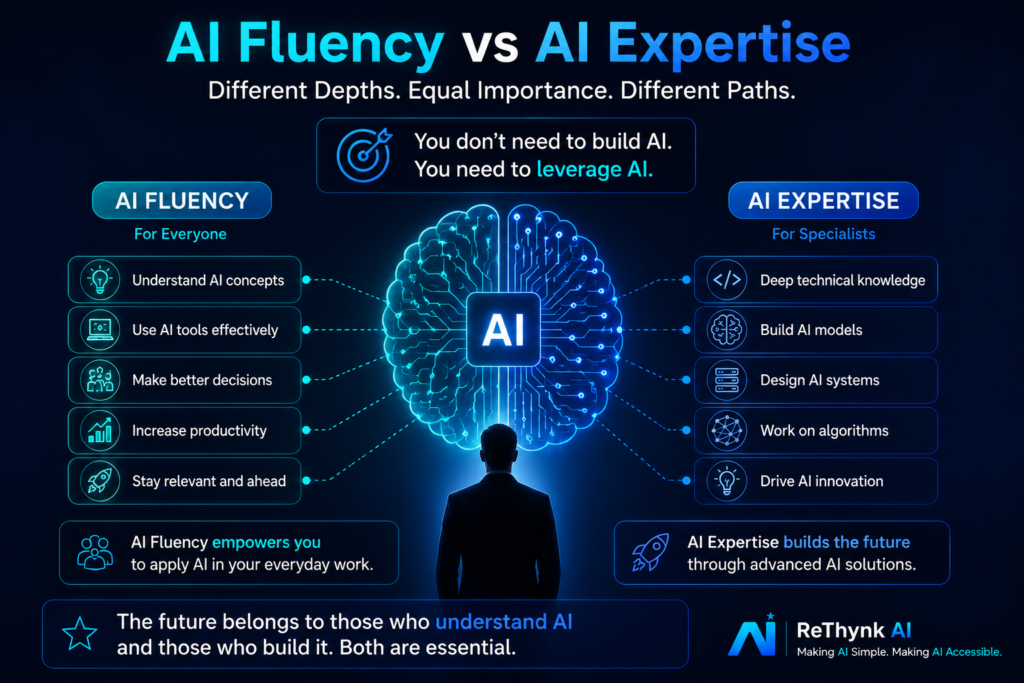
The AI era does not require everyone to become AI experts.
It requires everyone to become AI fluent.
Understanding this difference is one of the most important mindset shifts of the coming decade.
What Is AI Expertise?
AI expertise refers to deep technical knowledge involved in designing and building AI systems.
Experts typically work with:
- Machine learning algorithms
- Neural networks
- Data engineering
- Python programming
- Model training and optimization
- Statistical analysis
- Large language models
- AI infrastructure
AI experts create the technology.
Their work makes AI possible.
They are the architects behind intelligent systems.
These roles are highly valuable, but they represent only a small percentage of the workforce.
Not everyone needs to become an AI engineer.
Just as not everyone needed to become a software developer during the internet revolution, not everyone needs to become an AI specialist today.
What Is AI Fluency?
AI fluency is the ability to understand, communicate with, and effectively use AI systems to solve real-world problems.
AI fluency focuses on application rather than construction.
An AI-fluent individual knows:
- What AI can do
- What AI cannot do
- How to ask better questions
- How to evaluate AI outputs
- How to integrate AI into daily work
- When human judgment is required
AI fluency is similar to digital literacy.
Millions of people use computers every day without knowing how operating systems are built.
Likewise, millions will use AI effectively without understanding how transformer models are trained.
The goal is not technical mastery.
The goal is practical capability.
AI Expertise Builds AI. AI Fluency Uses AI.
Think about automobiles.
Most people know how to drive a car.
Very few know how to manufacture engines.
Driving requires fluency.
Building engines requires expertise.
Both are valuable.
But society needs far more drivers than engine designers.
The same principle applies to AI.
AI experts build the systems.
AI-fluent people apply those systems to create value.
Doctors, marketers, entrepreneurs, teachers, consultants, researchers, writers, and managers do not necessarily need to develop AI models.
They need to understand how AI can improve their work.
That difference matters.
Why AI Fluency Matters More for Most Professionals
Technology has always rewarded adaptation.
Today, the competitive advantage no longer comes only from knowledge.
It comes from the ability to use knowledge effectively.
AI enables professionals to:
- Research faster
- Generate ideas
- Automate repetitive tasks
- Analyze information
- Create content
- Improve decision-making
- Increase productivity
These benefits do not require advanced programming skills.
They require understanding how to collaborate with AI.
The future workplace will increasingly reward people who know how to combine human intelligence with artificial intelligence.
The Risk of AI Dependency
AI fluency does not mean blindly trusting machines.
In fact, one of the greatest dangers of the AI era is overdependence.
An AI-fluent professional treats AI as a collaborator.
An AI-dependent professional treats AI as an authority.
These are not the same.
AI systems can hallucinate.
They can make incorrect assumptions.
They lack context, emotions, ethics, and lived experience.
Human judgment remains essential.
Critical thinking becomes more valuable, not less.
The professionals who thrive will be those who know when to trust AI and when to challenge it.
AI Skills Everyone Should Develop
Regardless of profession, several skills are becoming increasingly important.
Prompt Communication
Knowing how to provide clear instructions and context to AI systems.
Critical Thinking
Evaluating outputs instead of accepting them blindly.
Problem Solving
Using AI to accelerate solutions rather than replace thinking.
Adaptability
Remaining open to new tools and changing workflows.
Human Skills
Creativity, empathy, leadership, ethics, and strategic thinking continue to matter.
Technology amplifies these qualities.
It does not replace them.
The Future Belongs to AI-Fluent Humans
Throughout history, technological revolutions have created opportunities for those willing to learn.
The internet rewarded digital literacy.
The AI era will reward AI fluency.
Not everyone needs to become an AI engineer.
Not everyone needs to write machine learning algorithms.
But everyone can learn how to think and work alongside intelligent systems.
The goal is not to compete with AI.
The goal is to collaborate with it.
Because ultimately, the future will not belong to those who fear AI.
Nor will it belong only to those who build AI.
It will belong to those who understand how to use it wisely.
Final Thoughts
At ReThynk AI, we believe AI should empower people, not intimidate them.
Our mission is simple:
To help individuals and organizations move from fear to fluency in Artificial Intelligence.
AI expertise will remain essential.
But AI fluency will become universal.
And the sooner we embrace that distinction, the better prepared we will be for the future ahead.
About ReThynk AI
ReThynk AI Innovation and Research Pvt. Ltd. helps individuals and organizations make AI practical, ethical, and accessible through research, education, and implementation frameworks. We believe technology should amplify human potential, not replace it.