
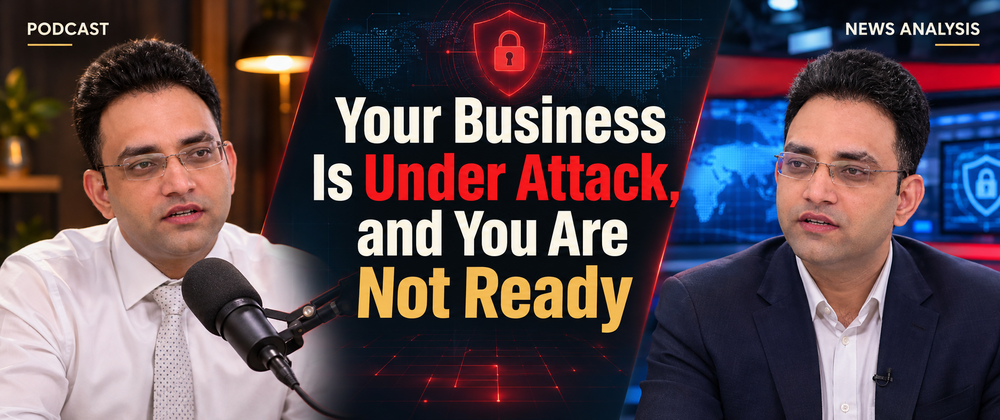
Recent disruptions across banking, aviation, technology, and government systems reveal why cybersecurity, AI readiness, and business continuity must become leadership priorities, and CEOs need to prepare for a cyberattack.
Imagine arriving at your office tomorrow morning and discovering that your company’s systems have been compromised.
Your employees cannot access important files.
Customer information may have been stolen.
Your payment systems are unavailable.
Someone has gained unauthorized access to confidential business documents.
And your technology team is struggling to determine what happened.
Now imagine receiving a message demanding money in exchange for restoring access to your systems.
What would you do?
Would your business continue operating?
Could you recover your information?
Would you know whom to contact?
And, perhaps most importantly, are you confident your organization is prepared for such a situation?
I have been thinking about these questions while studying the recent disruptions involving Microsoft 365, JPMorgan Chase, the Federal Aviation Administration (FAA), the National Security Agency (NSA), Apple, and other technology services.
As an entrepreneur and AI researcher, I find these developments increasingly concerning.
Not because every disruption is necessarily a cyberattack.
But because they reveal how dependent our businesses have become on digital infrastructure.
My concern is that companies are racing to become AI-powered while many have not adequately secured the systems on which their businesses already depend.
And I believe this could become an expensive mistake.
The Recent Disruptions Should Be a Warning
Between November 12 and November 17, 2026, several major organizations experienced significant technological failures.
Microsoft 365 services became unavailable.
JPMorgan Chase experienced transaction-processing problems that affected banking services.
The FAA experienced a communications disruption that led to a nationwide ground stop.
The NSA reported degradation of an internal communications network.
Apple also experienced problems affecting several digital services.
According to the organizations involved and American authorities, the available evidence does not establish that these incidents were coordinated cyberattacks.
Several were attributed to software defects, system updates, maintenance activities, or infrastructure problems.
We should respect those findings.
But another development deserves attention.
During the same period, researchers discovered a genuine software supply-chain attack involving Optimizely, a platform used by many major websites.
Malicious code was distributed through affected website integrations associated with 178 organizations, including websites belonging to Zoom, HSBC, CNN, and others.
The code attempted activities including stealing payment information and redirecting cryptocurrency transactions.
Importantly, the presence of malicious code on an organization’s website does not automatically mean its internal systems or customer databases were compromised.
Still, this incident demonstrates how a vulnerability in one technology provider can expose many other organizations.
I believe the lesson is clear.
A business does not need to be the primary target of an attacker to suffer the consequences of a security weakness somewhere in its digital ecosystem.
Are Businesses Really Prepared?
I believe many organizations have confused purchasing cybersecurity technology with achieving cybersecurity readiness.
They install antivirus software.
Purchase firewalls.
Subscribe to cloud services.
Hire technology professionals.
And assume their digital infrastructure is protected.
But cybersecurity is not a product that can simply be purchased and forgotten.
It is an ongoing responsibility.
According to the World Economic Forum’s Global Cybersecurity Outlook 2026, only 19% of surveyed organizations reported that their cyber resilience exceeded their minimum requirements.
The same research identified emerging technologies, supply-chain vulnerabilities, and cybersecurity skills shortages among major challenges.
This does not prove that most businesses are completely unprepared.
But it suggests that substantial weaknesses and uncertainties remain.
From my experience with Lean Six Sigma and process excellence, I have learned that a system should not be evaluated only by how efficiently it performs under normal conditions.
We must also examine how it behaves when something goes wrong.
A company can have excellent productivity and still possess serious operational vulnerabilities.
Business efficiency without resilience can become a very expensive illusion.
The AI Integration Race May Be Creating Additional Risks
This is perhaps my biggest concern.
Almost every business wants to integrate artificial intelligence.
Companies are deploying AI assistants, connecting applications through APIs, automating workflows, and experimenting with autonomous agents.
I welcome technological progress.
But I keep asking one question.
Are these companies securing their existing systems before connecting increasingly capable AI applications to them?
Imagine a business giving an AI agent access to its customer database, email system, financial records, and document storage.
The objective is to increase productivity.
But what happens if the agent receives excessive permissions?
What if an attacker compromises its credentials?
What if malicious instructions hidden inside an external document cause the AI system to perform an unauthorized action?
Or what if employees submit confidential customer information to an AI platform that has not been approved by the organization?
These are realistic categories of security risk.
AI can increase the speed at which work is completed, but it can also introduce new ways for unauthorized actions to occur.
This is why I believe organizations must evaluate AI readiness through the lens of cybersecurity, governance, and process design.
Before giving AI access to a system, we should understand what that system contains, what the AI is permitted to do, and how we will detect and stop inappropriate actions.
Technology integration without adequate safeguards is not necessarily transformation.
It can become risk accumulation.
How I Would Prepare a Business for a Cyberattack
If I were assessing an organization’s cybersecurity readiness, I would begin with its critical business processes.
The National Institute of Standards and Technology’s Cybersecurity Framework 2.0 provides a useful foundation through six functions: Govern, Identify, Protect, Detect, Respond, and Recover.
I would translate those principles into practical business actions.
1. Identify What the Business Cannot Afford to Lose
Every organization has critical assets.
Customer databases.
Financial information.
Intellectual property.
Employee records.
Production systems.
Research documents.
Confidential contracts.
The first responsibility is to identify these assets and understand where they are stored.
Then examine who can access them.
I would also identify which business activities depend on each system.
For example, if a customer database becomes unavailable for 48 hours, what happens to sales and customer service?
If a payment system fails, can essential transactions continue?
You cannot adequately protect what you have not identified.
2. Secure Access Before Expanding Automation
One of the most important security principles is restricting access to what people and systems actually need.
Employees should not automatically have access to every business application.
AI agents should not receive unrestricted permissions simply because doing so makes integration easier.
I would prioritize phishing-resistant multifactor authentication wherever supported, strong identity management, least-privilege access, timely security updates, and appropriate network segmentation.
Administrative accounts deserve particular attention.
A compromised account with extensive privileges can create far greater damage than one with limited access.
The objective is not merely preventing every possible intrusion. It is also limiting the damage when an account or system is compromised.
3. Evaluate Every AI Integration Before Deployment
I would establish a mandatory security review before introducing AI applications into critical workflows.
The review should answer several questions.
What data will the AI access?
Where will the information be processed?
Can the AI retain or share the information?
What actions can it execute?
Does it require access to external websites or applications?
How will the organization monitor its activities?
And can its access be revoked immediately?
High-risk actions involving payments, confidential information, or major system changes should have appropriate authorization controls.
I would not permit an experimental AI agent to operate with production-level authority merely because a demonstration performed successfully.
A working prototype is not proof of a secure production system.
4. Examine Third-Party Dependencies
The recent Optimizely incident demonstrates why supplier security matters.
Organizations frequently depend on external software, payment providers, website integrations, cloud platforms, and technology vendors.
Each relationship can introduce additional exposure.
I would encourage businesses to maintain a current inventory of important vendors and software integrations.
Understand what information those vendors can access.
Review their security arrangements.
Remove unnecessary integrations.
And establish procedures for responding when a supplier reports a security incident.
Businesses should also understand whether multiple critical services depend on the same provider.
A company can protect its own infrastructure carefully and still become exposed through an inadequately secured dependency.
5. Prepare Backups That Can Actually Be Restored
Imagine an organization discovering that attackers have encrypted its business data.
The company announces that backups are available.
But when employees attempt recovery, they discover that the backups are incomplete, corrupted, or accessible to the same compromised accounts.
This would be disastrous.
I would recommend maintaining protected, appropriately isolated backups for critical business information, including offline or immutable copies where feasible.
But creating backups is only half the responsibility.
Organizations must test restoration.
How long does recovery take?
Which systems should be restored first?
How much recent data could be lost?
These questions should be answered before an incident occurs.
6. Build an Incident Response Plan Before the Emergency
During a security incident, confusion can make the situation worse.
Employees may not know whom to contact.
Managers may issue conflicting instructions.
Important evidence may be lost.
Customers may receive inaccurate information.
I believe every organization needs a clearly documented incident response plan.
The plan should establish who has authority to declare an incident, involve qualified technical responders, coordinate containment and recovery, contact legal advisers, and communicate with affected stakeholders.
It should also address relevant regulatory and breach-notification obligations.
A suspected breach may require preserving logs and other evidence, isolating affected systems, and investigating the scope of compromise.
Employees should not attempt improvised technical interventions beyond their training or authority.
And a ransomware demand should never automatically become a payment decision.
Such situations require professional technical, legal, and law-enforcement guidance.
Most importantly, the plan must be tested.
An emergency procedure that exists only in a document is not the same as an organization capable of executing it.
What I Would Do in the First 30 Days
If an organization currently lacks a structured cybersecurity programme, I would not recommend attempting to solve everything immediately.
I would establish priorities.
During the first week, identify critical systems, sensitive information, administrative accounts, and business dependencies.
Next, address the most urgent exposures, particularly weak authentication, unnecessary permissions, unsupported software, and missing backups.
Then examine important suppliers and AI integrations.
Finally, conduct a tabletop exercise.
Present the leadership team with a realistic scenario:
Our customer database is inaccessible, suspicious transactions have appeared, and our primary communication platform is unavailable.
Ask the team to explain what happens next.
Who makes the decisions?
Who contacts customers?
How does the business continue operating?
What evidence is preserved?
What is the recovery priority?
The answers will reveal gaps that ordinary meetings and presentations often fail to uncover.
For organizations with more complex systems, regulated activities, or critical infrastructure, these steps should be supported by qualified cybersecurity specialists and a more comprehensive risk assessment.
Cybersecurity Is Now a CEO's Responsibility
In my earlier article, Microsoft 365 Outage: Are Digital Businesses Prepared?, I discussed how digital transformation can introduce hidden operational dependencies.
I expanded this discussion in Global Cyberattack Warning: Are We Ready for Digital War in 2027?.
I also addressed the wider national-security implications in my YouTube lecture, Cyberattacks in 2027? Is the World Prepared for a Digital War?.
My concern remains the same.
We are becoming increasingly dependent on interconnected technology while geopolitical tensions, software vulnerabilities, and cyber threats continue evolving.
I believe cybersecurity can no longer remain exclusively within the IT department.
It belongs in board meetings.
It belongs in business strategy.
It belongs in risk management.
And it must influence decisions about artificial intelligence.
A CEO does not need to personally configure every security control.
But they should understand the business consequences of a major cyber incident and ensure that qualified people have the resources and authority to manage those risks.
Final Thoughts: Don't Wait for an Attack to Discover Your Weaknesses
I don’t know when the next major cyberattack will occur.
I cannot predict which organization or country will become its target.
And I do not believe we should label ordinary technical failures as attacks without supporting evidence.
But I do believe one thing.
Businesses that neglect cybersecurity are accepting risks that may become far more expensive than the cost of reasonable preparation.
The consequences can involve lost revenue, stolen information, privacy violations, operational disruption, legal liabilities, and damaged customer confidence.
As an entrepreneur and researcher, I see cybersecurity as part of responsible business leadership.
We should continue adopting AI.
We should automate processes.
We should develop intelligent systems.
But we should not introduce new capabilities faster than our ability to govern and protect them.
The greatest mistake would be believing that cybersecurity can be addressed after digital transformation is complete.
Cybersecurity should not be the final stage of digital transformation. It should be one of its foundations.
Because when a serious cyberattack occurs, the question will not be how many AI tools the company has integrated.
It will be whether the organization can protect its people, preserve essential information, maintain critical operations, and recover.
And I believe every business leader should be able to answer that question before the next crisis arrives.
Frequently Asked Question
What should a business do first to prepare for a cyberattack?
Start by identifying critical data, systems, services and the business consequences of losing access to them. This inventory helps establish which assets require the most urgent protection. NIST’s small-business guidance recommends identifying assets and assessing their importance to business operations. nist.gov Then prioritize access controls, security updates, protected backups and a documented incident response plan.
What security checks should businesses complete before deploying AI agents?
Businesses should establish what information an AI agent can access, which actions it can perform and which external applications it connects to. Apply least-privilege permissions, require authorization for sensitive actions, monitor activity and ensure access can be revoked quickly. Review how the AI provider processes and retains confidential information.
How can ReThynk AI help businesses plan responsible AI adoption?
ReThynk AI offers AI strategy consulting, corporate training and process excellence support. These services help leaders examine workflows, define governance responsibilities and establish approval requirements before expanding AI adoption. Visit ReThynk AI to discuss an AI strategy session or corporate workshop.
Research & Reference
1. CSA Lab Space: The November Outage Cluster: Correlated Fragility and Attribution by Cloud Security Alliance AI Safety Initiative, Date: 18.11.2026
2. Reuters: Popular Websites Compromised in Bid to Steal Crypto, Target iPhone Users by Reuters, Updated: 18.11.2026
3. World Economic Forum: Global Cybersecurity Outlook 2026, Report January 2026
4. World Economic Forum: Point 3: The Trend Reshaping Cybersecurity, Global Cybersecurity Outlook, 2026, Report January 2026
5. NIST: NIST Cybersecurity Framework 20.: Small Business Quick-Start Guide, By Daniel Eliot, Date: 26.02.2024
6. Federal Trade Commission: Cybersecurity for Small Business, September 2025
7. ReThynk AI: Microsoft 365 Outage: Are digital business prepared? by Jaideep Parashar, Date: November 18, 2026
8. ReThynk AI: Global Cyberattack Warning: Are we ready for digital war in 2027? by Jaideep Parashar, Date: November 20, 2026
9. Jaideep Parashar: Cyberattacks in 2027? Is the world prepared for a digital war? by Jaideep Parashar, Date: November 20, 2026